Atomic Space, the desktop edition
The team's original Windows game, written in Delphi (Object Pascal, VCL). Pick a lunar mission, build the rocket, convince the review board, then launch, stage, fly to the Moon and land. Every part changes cost, mass, thrust and fuel.
Windows 10 or 11. No install: unzip and run AtomicSpace.exe.
The program is not code-signed, so SmartScreen may ask you to choose More info then Run anyway.
No phone or Mac? The browser edition runs on any device.
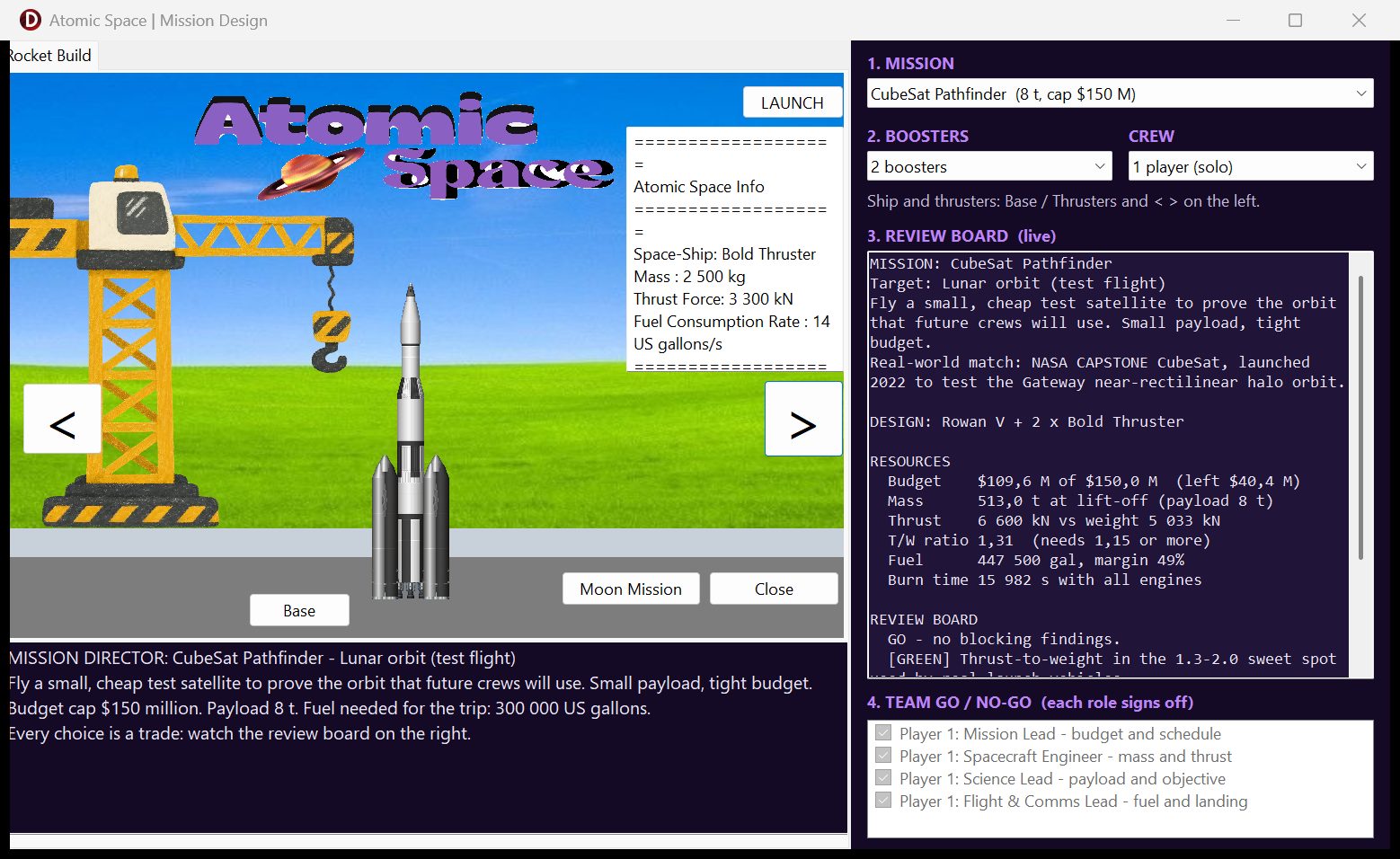
How a mission goes
- Choose a mission. Each has a payload, a cost cap and the fuel the trip needs. They are modelled on NASA's CAPSTONE CubeSat, the Lunar Reconnaissance Orbiter and the CLPS / Artemis cargo landers.
- Build the rocket. Three ships, three thrusters, two or four boosters. That makes 18 combinations, and every mission has more than one that works.
- Pass the review board. RED findings block launch. AMBER ones are risks you choose to accept. GREEN ones are strengths.
- Team go / no-go. With two to four players, every role has to sign off: Mission Lead, Spacecraft Engineer, Science Lead, and Flight & Comms Lead. Change the design and the sign-offs reset.
- Launch. Countdown, lift-off only if thrust beats weight, fuel drains in real time, and the boosters separate at 100,000 ft.
- Fly to the Moon. Hold a 100 km orbit, then land by hand or with the autopilot. A thin fuel margin at design time means a low tank now.
- Read the report. You get a score out of 100 and a grade, the reasons behind them, and the real mission yours resembles.
The trade-offs
Thrust-to-weight
Thrust ÷ (mass × 9.81). Below 1 the rocket cannot leave the pad. Below 1.15 it wastes fuel fighting gravity. Above 2.5 you paid for thrust you did not need.
Budget
Ship + boosters + payload must fit the cost cap. Keeping a 20% reserve scores best, because real projects that overrun get cancelled.
Payload vs ship
Bigger ships carry more and hold more fuel, but they are heavier and dearer, so they need more boosters.
Fuel margin
The tank has to cover the trip. The spare fuel is what you get to land with.
Ships and thrusters
| Part | Mass | Thrust / payload | Fuel | Cost |
|---|---|---|---|---|
| Rowan V (ship) | 500 t | 70 t payload | 447,500 gal | $73 M |
| Mighty-Eagle (ship) | 600 t | 90 t payload | 500,500 gal | $92 M |
| Blue Atom (ship) | 700 t | 120 t payload | 630,000 gal | $141 M |
| Atomic Thruster | 2.0 t | 2,800 kN | 12 gal/s | $11 M each |
| Bold Thruster | 2.5 t | 3,300 kN | 14 gal/s | $15.3 M each |
| Nova Thruster | 1.5 t | 3,800 kN | 9 gal/s | $24.5 M each |
These are simplified teaching values, not engineering data.
Two editions, one team
The browser edition is the full game: five missions from Earth orbit to Europa, live NASA data (EONET, DONKI, NeoWs, GIBS), and 15 instruments. It is written in Object Pascal too, compiled to JavaScript with pas2js. The desktop edition is the Delphi game it grew from, now with mission choice, a review board, team sign-off and scoring.